Welcome to the Linley Lab
We are an interdisciplinary chemical engineering research group at McMaster University focused on developing and testing functional materials for environmental and sustainability applications.
Recent News
08/04/2026
Stuart will be chairing a symposium on (CA) Catalysis: Photochemistry, Artificial Photosynthesis, and Solar Fuels at x2026 from May 24-28 in Toronto. Come and say hi and learn about exciting advances in the world of solar fuels.
30/01/2026
We are thrilled to welcome Kora Rakhsha to the team as our first Postdoctoral Fellow!
27/01/2026
Stuart's new perspective on floating solar reforming published in Nature Chemical Engineering
05/09/2025
We are thrilled to welcome Emma Brakwah to the team as our second PhD student!
Sustainability
Our every day life is made possible through thousands of different chemicals - everything from your dish soap to your t-shirts are derived from oil-based chemicals. The expansive chemicals industry accounts for 30% of industrial energy use and 14% of global oil demand, half of which is used as feedstock material. Much of what we create was never intended for perpetual use: every year, consumers discard 2 billion tonnes of waste, of which 1.4 billion tonnes goes directly to landfill.
Some of our most materially wasteful commodities are fuels. By producing fuels from fossil feedstocks, every year we release 8.1 billion tonnes of CO2 equivalents into the atmosphere. Even our leading fuel replacement, H2 is carbon-positive, with 95% of hydrogen on the market produced from methane:

To improve the sustainability of our economy, we need to consider how industry and consumer waste can be chemically reformed to create new commodities. This 'circular economy' treats waste as a resource and uses renewable sources of energy to limit emissions and create value.
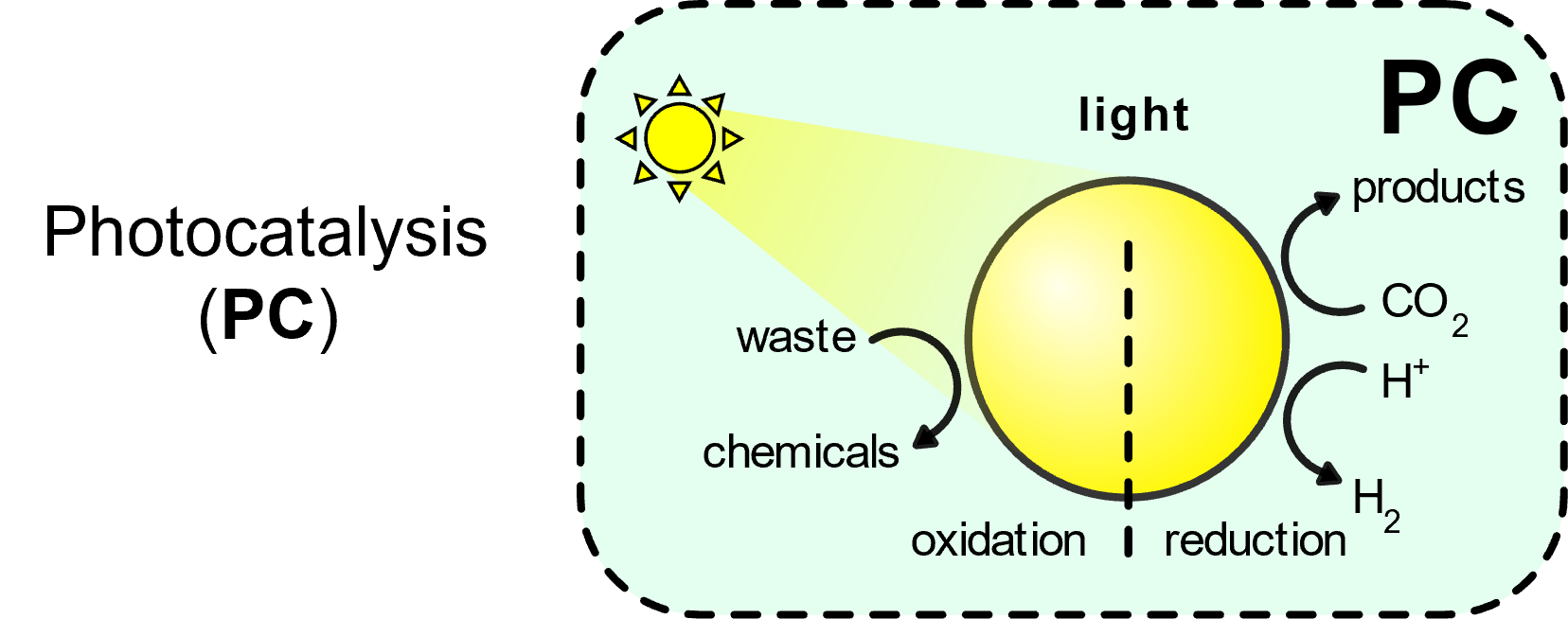
The Linley Lab is working on direct sunlight-powered solutions for sustainable production of fuels and chemicals from waste carbon to reduce the environmental impact of industry. Our core interest is solar reforming, a photocatalytic process that uses electrons from waste carbon to produce high-energy molecules like H2.